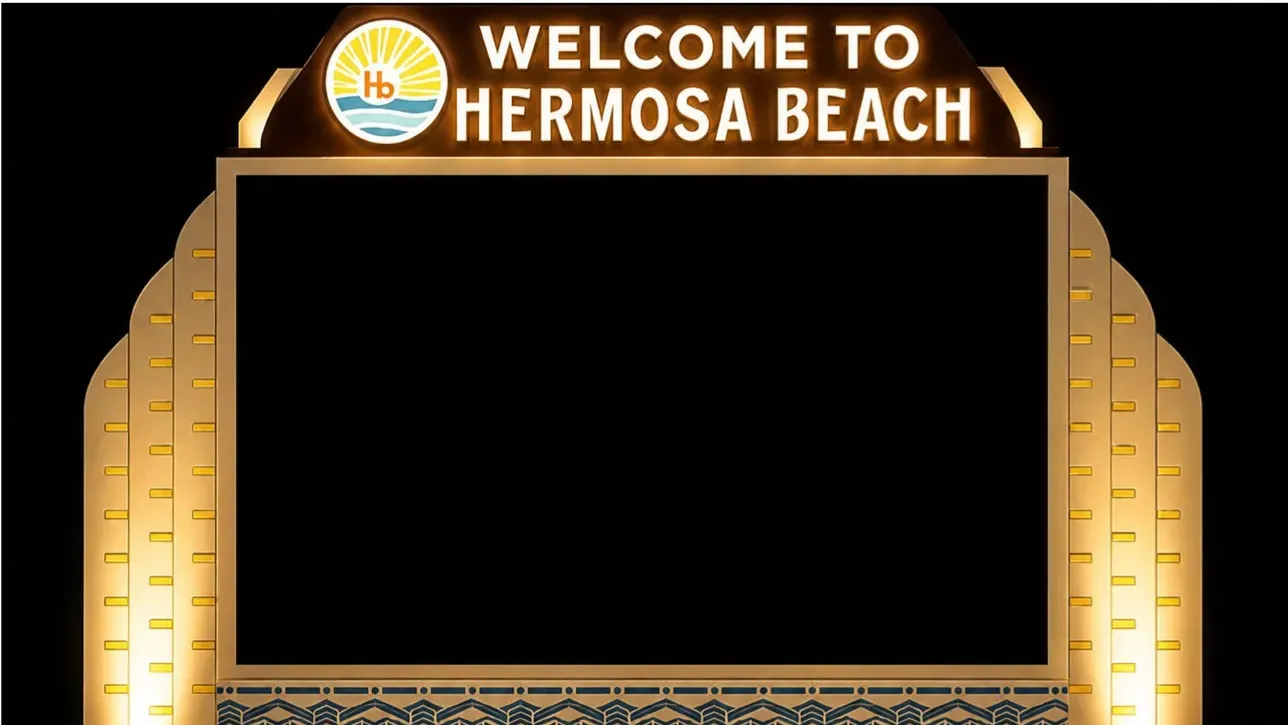
A new Art Deco-styled digital sign will greet drivers entering Hermosa Beach at Pier Avenue and Pacific Coast Highway after the Planning Commission voted 4-0 on Tuesday, Aug. 18, to approve the project.
The dual-sided electronic monument sign will stand 8.5 feet tall and 12 feet wide on the lawn of the Community Center at 710 Pier Ave., filling a spot that has sat empty since the previous sign was removed in 2019 over structural safety concerns. Its design echoes the 1930s Art Deco architecture of the Community Center, a locally designated historic landmark. The sign will feature an internally illuminated "Welcome to Hermosa Beach" greeting along with a roughly 4.7-by-8.9-foot digital display.
The project is largely privately funded. Former Mayor Chuck Sheldon and his wife, Missy Sheldon, donated $500,000 in December 2025 specifically for the sign. The Hermosa Beach Chamber of Commerce contributed $50,000 in 2014, and the remaining $28,845 will come from the city's general fund, the Daily Breeze reported.
"It can't be said too many times that their generous donation is what has allowed the city to get a major start on this particular project," Vice Chair Flaherty said during the hearing, referring to the Sheldons.
Assistant Planner Angelique Chavez told commissioners the digital display will be restricted to static messages only. No flashing, scrolling, animation or moving images are permitted. Content is limited to city business: community events, public meeting notices and emergency notifications. Commercial advertising and political messages are explicitly barred under the conditions of approval.
Any future decision to allow advertising would require separate review and approval by Caltrans, which regulates outdoor advertising visible from state highways, Public Works Director Joe SanClemente wrote in an Aug. 17 memo to the commission. Caltrans required the city to evaluate whether the display would hinder visibility of traffic signals but has not expressed concerns; the sign is ground-mounted to reduce potential conflicts with overhead signals.
The commission also adopted a CEQA Class 11 categorical exemption, classifying the sign as a minor accessory structure at an existing institutional facility. Commissioners acknowledged two public letters questioning how the sign would be used and financed but said those issues fell outside the panel's purview, which is limited to physical design, location and environmental review.
Commissioner Kate Hirsh said she was pleased to see the project reach this stage after hearing about it for years, adding that the design would "further beautify Hermosa." Chair Steve Izant called it a tremendous improvement over what previously existed at the site, according to the Hermosa Review.
The sign still needs City Council approval. The council could take up the item at its Sept. 22 meeting, though the city has not confirmed it is formally agendized. If approved, installation is anticipated in spring 2027.